Is there a Chinese alphabet? Letters, pinyin and characters
Short answer: no. Chinese is written with characters, not letters, and pinyin shows how each character is pronounced. How the two work, how an English speaker should read pinyin, how many characters are enough and how your name is written in Chinese, all with examples.
Contents
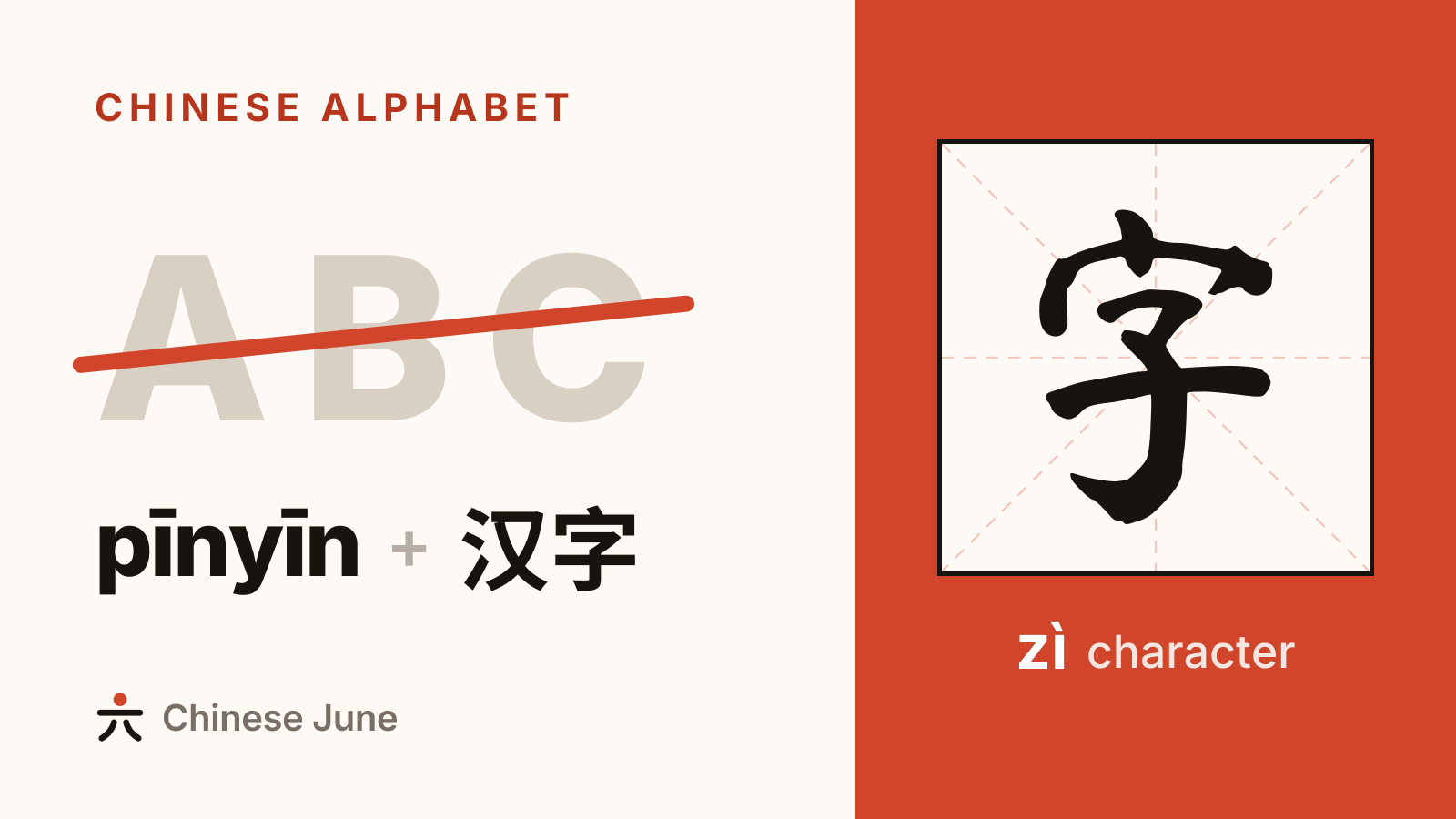
Chinese has no alphabet. The chart you are looking for, A to Z with a Chinese equivalent for every letter, has never existed. Chinese is written with characters (汉字, hànzì): each character is one syllable, and most of the time it carries a meaning of its own. To show how a character is pronounced there is pinyin, the spelling of Chinese sounds in Latin letters.
So in place of the one thing you expected there are two systems. One uses letters you already know, and its reading rules take a few evenings to learn. The other is less arbitrary than it first looks: a few hundred parts, combined over and over.
Let's start with the “Chinese alphabet” chart that goes around online, since you have probably seen it too.
Why is the “Chinese alphabet” chart online useless?
You know the one: A, B, C down the left, and beside each a Chinese character or two. 诶 for A, 比 for B, 西 for C. Underneath there is usually an invitation to “write your name in Chinese”.
The chart is not made up, but it is not an alphabet either. It writes the names of the English letters (ay, bee, see, dee…) with characters that sound like those names. 比, for B, is read bǐ. 西, for C, is read xī, which comes out as “shee”. W gets four characters at once, 豆贝尔维; read aloud, they start like “double”. What got written down is the name of the letter, not the letter.
The real problem is that each of those characters has a meaning of its own.
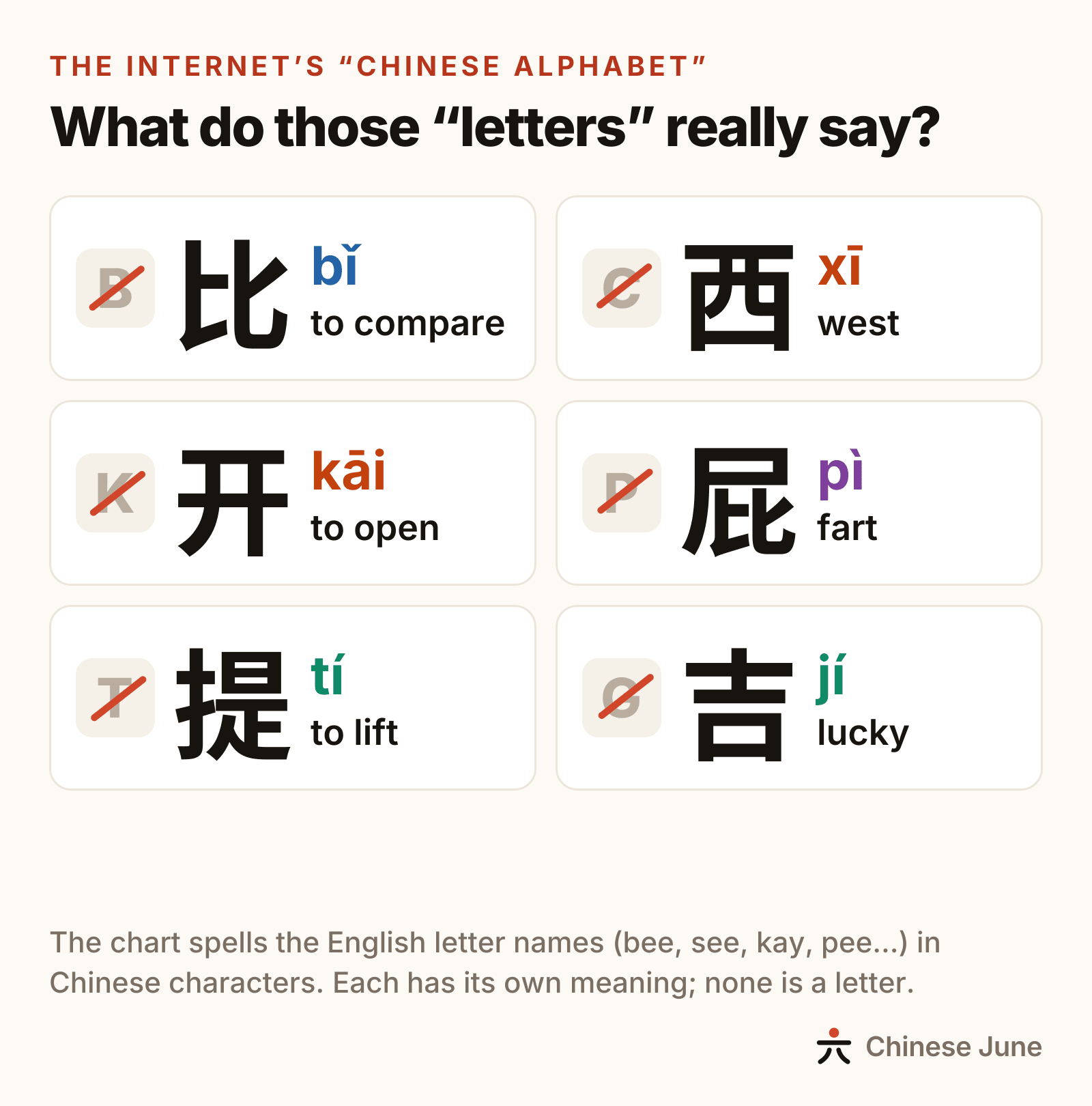
比 means “to compare”, 西 “west”, 开 “to open”. And 屁, the one for P, means “fart”. Spell your name letter by letter with this chart and you have not written anything meaningful, only a row of unrelated words. A Chinese reader cannot recover your name from that row, because Chinese writes foreign names syllable by syllable, not letter by letter, and with a different method altogether. We explain it further down.
If you are thinking about a tattoo, read this section twice.
What is Chinese written with?
A Chinese word comes in several layers, one on top of the other. Take the word for “China”:
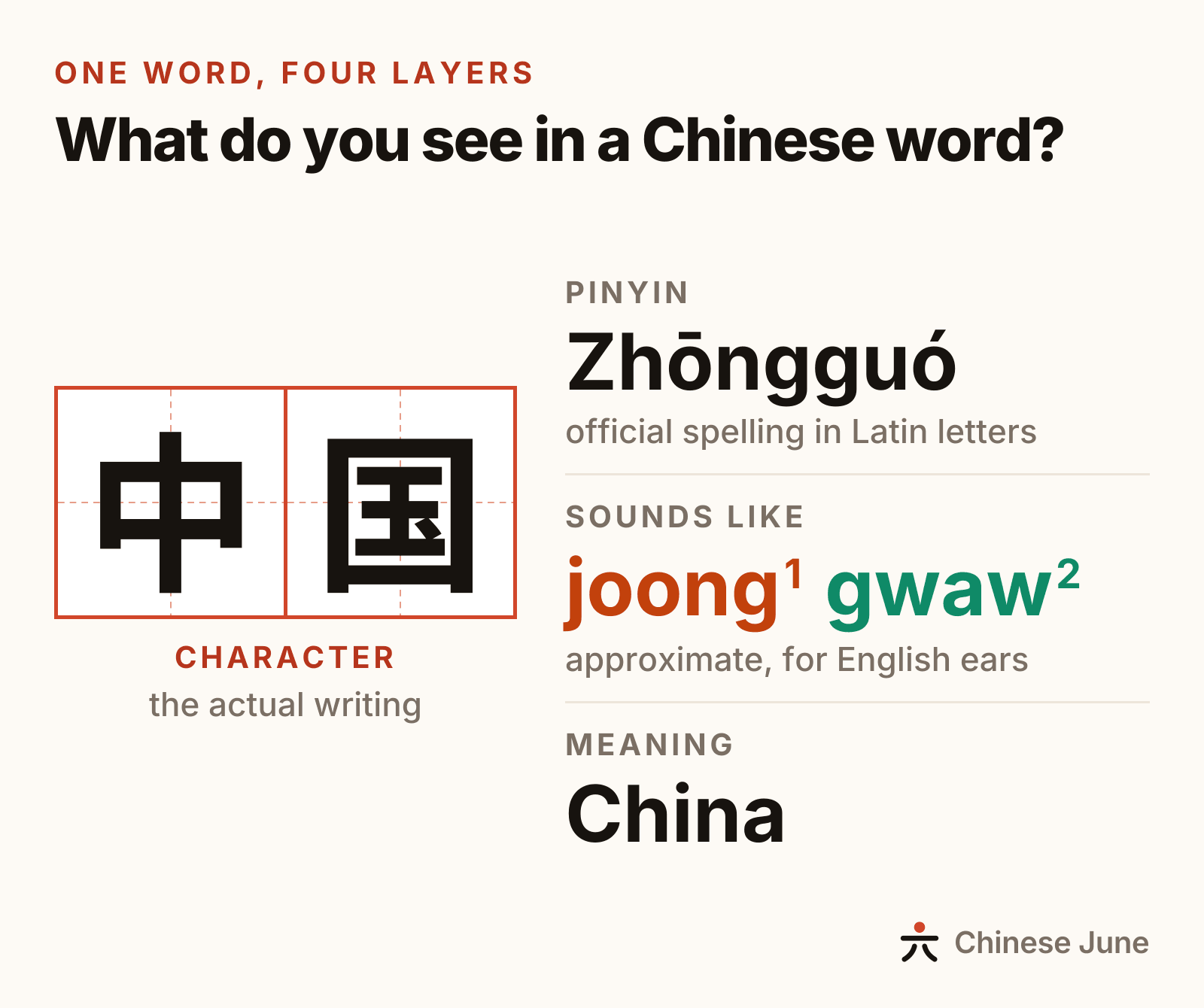
Character (汉字). This is the actual writing. Street signs, menus, newspapers, text messages: in China all of it is in characters. 中国 is two characters and two syllables: 中 “middle”, 国 “country”. China's own name for itself is, word for word, “middle country”.
Pinyin. The character's pronunciation spelled in Latin letters: Zhōngguó. The marks over the letters show the tone. Children in China learn to read and write with pinyin first, dictionaries are ordered by it, and it is how Chinese is typed on a keyboard. But text is not written in pinyin: you will not find a newspaper printed in it.
Sounds like. This layer is a help that we add. It respells the pinyin, approximately, the way English would write the sound down: joong1 gwaw2. The number at the end of each syllable is the tone. It does not replace pinyin; think of it as a note beside the pinyin that says “this letter is said roughly like this”.
Meaning. China.
On our cards every word comes with all four layers. A few examples from the HSK 1 deck:
- 你好nǐ hǎonee2 hao3HelloWord for word “you good”
- 谢谢xièxieshyeh4 shyehThank youThe second syllable is toneless and short
- 中国Zhōngguójoong1 gwaw2China“Middle country”
- 再见zàijiàndzai4 jyen4Goodbye“Again” + “to see”
You may have noticed something odd in the first row: pinyin gives 你 the third tone (nǐ), the “Sounds like” line gives it the second (nee2). It is not a mistake. When two third tones meet, the first is said as a second tone. Pinyin writes the dictionary form of the word; “Sounds like” writes what comes out of your mouth.
Pinyin: Chinese in Latin letters
Pinyin (拼音, pīnyīn) literally means “joining sounds”. It was officially adopted in China on February 11, 1958, and became the international standard in 1982 (ISO 7098). Zhou Youguang, the best-known name on the team behind it, was not even a linguist: he had studied economics, worked at a bank in New York in the late 1940s, and was called to the job after returning to China. He died in 2017, aged 111.
Pinyin uses 25 of the 26 Latin letters (native Chinese words have no v) and adds a ü. A syllable has three parts: an initial consonant, the vowel part that follows, and a tone. The official scheme has 21 initials and 35 vowel patterns. Tones aside, they make a little over 400 different syllables, very few next to English. That is why telling one syllable from another is so often left to the tone.
Good news and bad news for English speakers
The good news first. English has a “ch”, a “sh” and a “j”, and six pinyin consonants are close relatives of those three. The catch is that Chinese has two of each: one made with the tongue tip down (pinyin q, x, j) and one with it curled back (ch, sh, zh). The “Sounds like” line can only write “ch”, “sh” and “j” for both, so telling them apart is a job for your ears.
A few more things come free. The “ng” that ends so many Chinese syllables is the one in “song”, w and y are the glides of “way” and “yes”, and p, t, k take the puff of air English already gives them at the start of a word.
Now the bad news: three things English does not have.
The vowel ü. Say “ee” with your lips rounded. We write it “yu”: 女 (nǚ, woman) is nyu3. Watch one spelling rule: after j, q, x and y the two dots are not written, but the sound is still ü. 去 is spelled qù and said chyu4.
The buzzing syllables. After z, c, s and after zh, ch, sh, r, the letter i is not “ee”. There is no real vowel at all: you hold the consonant and let it buzz. We write exactly that: 是 (shì, to be) is shr4, 四 (sì, four) is sz4.
Plain b, d and g. They are not voiced as in English. They are closer to the p, t, k of “spy”, “sty” and “sky”, with no puff of air.
There is no shortcut for these three. A description gets you close; listening does the rest.
Letters that don't sound the way they look
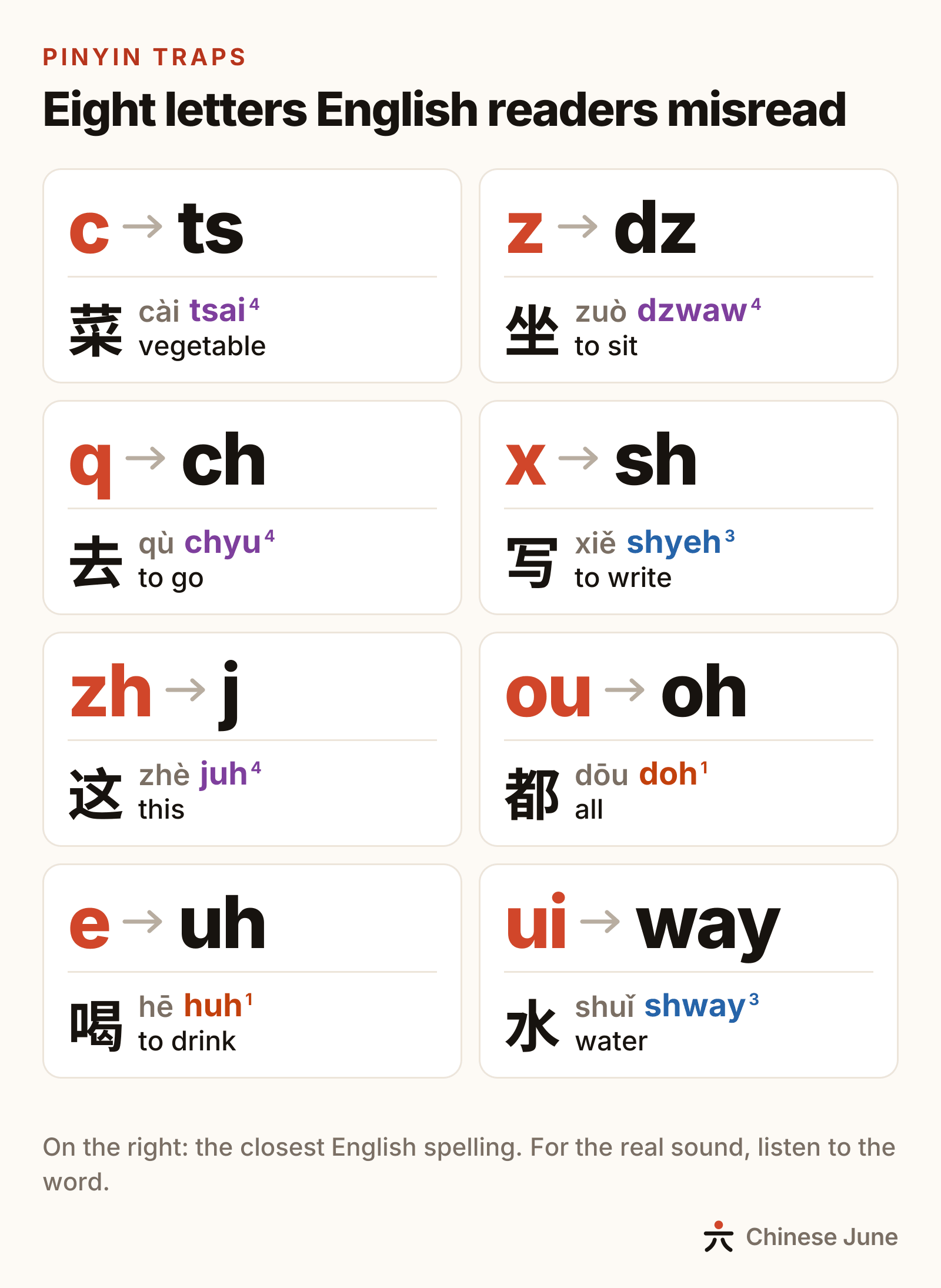
Pinyin uses Latin letters, but it is not English spelling. Read a few of them the English way and you have said a different word. The usual stumbling blocks:
| Pinyin | Closest in English | Example | Note |
|---|---|---|---|
| c | ts | 菜 cài → tsai4 (vegetable) | The “ts” in “cats”. Never “k” or “s” |
| z | dz | 坐 zuò → dzwaw4 (to sit) | The “ds” in “kids” |
| q | ch | 去 qù → chyu4 (to go) | The “ch” in “cheese”, tongue tip down. Never “kw” |
| x | sh | 写 xiě → shyeh3 (to write) | A thin “sh”, halfway to “s” |
| zh | j | 这 zhè → juh4 (this) | The “j” in “judge”, tongue curled back |
| j | j | 家 jiā → jyah1 (home) | The “j” in “jeep”. Not the “s” in “measure” |
| r | r | 人 rén → run2 (person) | An English r, tongue curled back |
| e | uh | 喝 hē → huh1 (to drink) | Never the “ee” of English “he” |
| ui | way | 水 shuǐ → shway3 (water) | Rhymes with “way” |
| ou | oh | 都 dōu → doh1 (all) | The “o” in “go”, never “oo” |
| ian | yen | 天 tiān → tyen1 (day) | Like the currency, not “ee-ahn” |
Pinyin ch and sh are the English sounds made with the tongue tip curled back. And h is rougher than in English, on the way to the “ch” of Scottish “loch”.
Once you know this table, a few Chinese names you have been hearing for years fall into place:
| The name you know | Chinese | Pinyin | Sounds like |
|---|---|---|---|
| Xiaomi | 小米 | Xiǎomǐ | shyao2 mee3 |
| Huawei | 华为 | Huáwéi | hwah2 way2 |
| BYD | 比亚迪 | Bǐyàdí | bee3 yah4 dee2 |
| Beijing | 北京 | Běijīng | bay3 jeeng1 |
| Xi Jinping | 习近平 | Xí Jìnpíng | shee2 jeen4 peeng2 |
| Tsingtao (the beer) | 青岛 | Qīngdǎo | cheeng1 dao3 |
| feng shui | 风水 | fēngshuǐ | fung1 shway3 |
Xiaomi literally means “millet”. BYD starts with 比, the B of the fake alphabet; it was not a letter there and it is not one here, it only supplies the sound “bee”. The j in Beijing is the plain j of “jeep”: “bay-jeeng”, not the “bay-zhing” many English speakers say. Tsingtao on the beer label is the city of Qingdao in an older spelling; either way it starts with “ch”. And feng shui, “wind and water”, is the rare case English already says about right.
Tones
The marks over the letters in pinyin are not decoration. In Chinese the melody of a syllable is part of the word: the same “ma” is mother when said high and level, and horse when it dips and rises. Standard Chinese has four tones and a toneless, neutral one:
| Tone | Pinyin | Sounds like | How the voice moves | Example |
|---|---|---|---|---|
| 1st tone | mā | mah1 | High and level; the “ahhh” the doctor asks for | 妈 mother |
| 2nd tone | má | mah2 | Rises from low to high; like asking “What?” | 麻 hemp |
| 3rd tone | mǎ | mah3 | Dips, then rises; a doubtful “We-ell…” | 马 horse |
| 4th tone | mà | mah4 | Drops sharply from the top; a firm “No!” | 骂 to scold |
| Neutral | ma | mah | Short and light; the second syllable of “sofa” | 吗 question particle |
English has nothing like the 吗 in the last row. Put at the end of a statement, it turns it into a yes-or-no question and leaves the word order alone: 你好吗? is “How are you?”. The nearest feeling in English is a tacked-on “…, right?”, except that 吗 is neutral and does not fish for a yes.
On our cards, too, every syllable is written in the color of its tone; the table uses the same colors. Tones cannot be learned from the page: you have to listen. That is a subject for a post of its own.
How do characters work?
Everyone's first thought on seeing characters is the same: thousands of separate pictures, to be memorized one by one. It is not like that. The great majority of characters are different arrangements of parts, and there are no more than a few hundred parts. Once you start to recognize them, a new character stops being “a new picture” and becomes “two familiar parts put together”.
The ones that come from pictures
The oldest characters really were drawings. Some of them, more than three thousand years on, still look like the thing they drew.
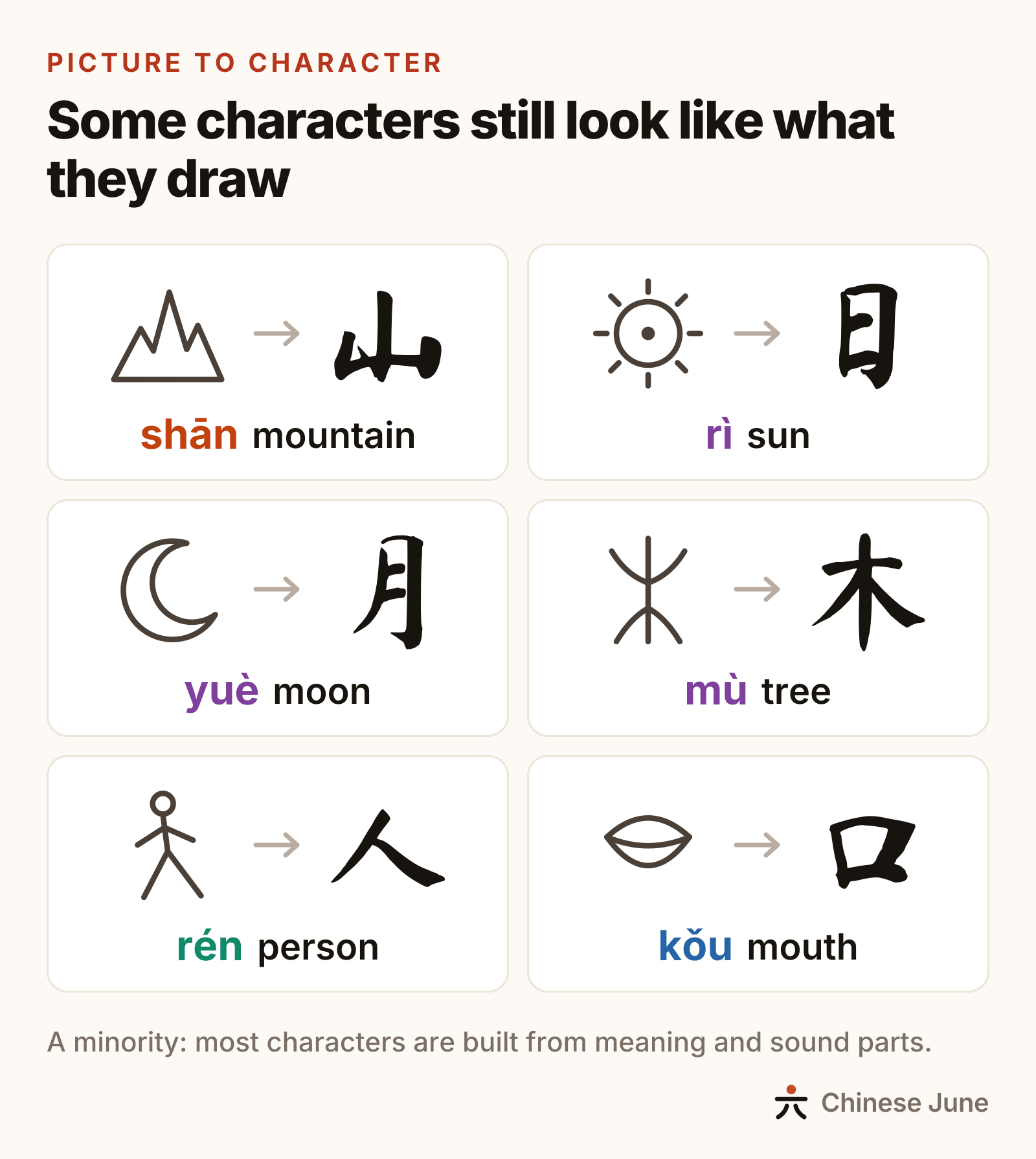
山 is the three peaks of a mountain, 口 an open mouth, 木 a tree with its branches and roots. These are the most fun to learn, but they are a minority. You cannot draw “economy”, “because” or “yesterday”. Chinese solved that problem another way.
One part for meaning, one part for sound
Most characters are built from two parts: one hints at the area of meaning, the other recalls the pronunciation. The share depends on which set of characters you count; the figure quoted most often is around 80 percent.
Take 马 (mǎ), “horse”. Inside another character it no longer says “horse”; it says “this character sounds like ma”.
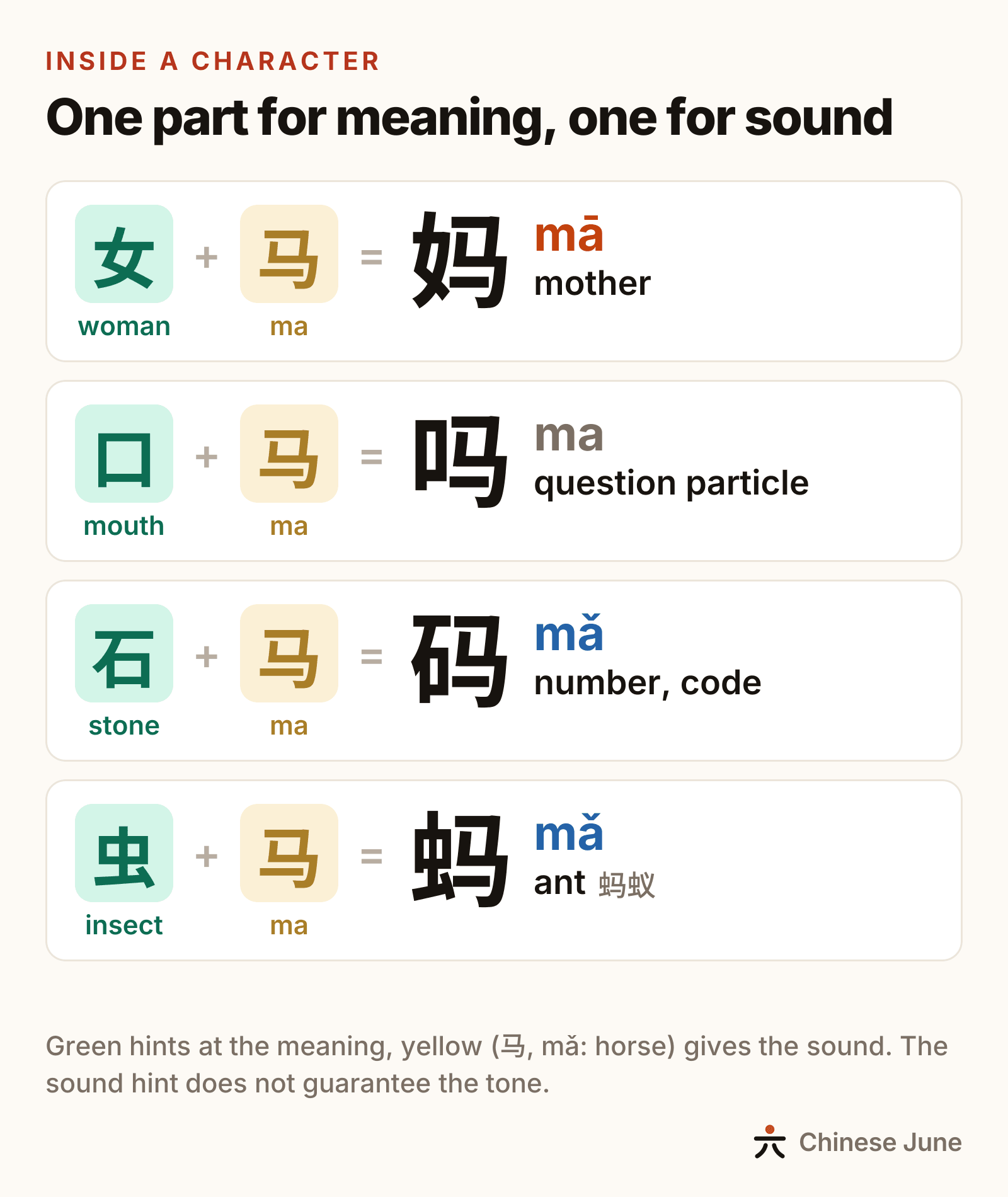
The 女 on the left of 妈 means “woman”: something to do with women that sounds like “ma”, so mother. The 口 in 吗 is “mouth”: something out of the mouth that sounds like “ma”, so a question particle.
Two warnings. The sound part does not give the tone: 妈 is first tone, 码 is third. And sometimes it misses the sound a little too, because these characters were built on the pronunciation of two thousand years ago and the language has changed since. Take it as a hint, not a rule.
The meaning parts are called radicals (部首, bùshǒu). The classical dictionary order has 214 of them; China's current official list has 201. Paper dictionaries arrange characters by them. You do not have to memorize them all up front; knowing just the few dozen most common ones already changes a lot. Three drops on the left (氵) mean water is involved: 河 river, 海 sea, 汤 soup, 洗 to wash. 口 turns up in things done with the mouth: 吃 to eat, 喝 to drink, 叫 to call, 唱 to sing.
A character is not a word
A character is one syllable and, most of the time, one unit of meaning. Most everyday Chinese words, though, are two characters. The nice part is that the combinations usually make sense:
- 电脑diànnǎodyen4 nao3Computerelectric + brain
- 手机shǒujīshoh3 jee1Mobile phonehand + machine
- 医院yīyuànee1 yuen4Hospitalmedicine + institution
- 明天míngtiānmeeng2 tyen1Tomorrowbright + day
So a character you learn earns you more than one word: it opens the door to every word it appears in. Learn 电 (electricity) once and 电话 (telephone: electric + speech), 电视 (television: electric + to look) and 电影 (movie: electric + shadow) become guessable.
Stroke order
Every character is written in a set order: top to bottom, left to right. A stroke that cuts through the middle of the character is left for last.
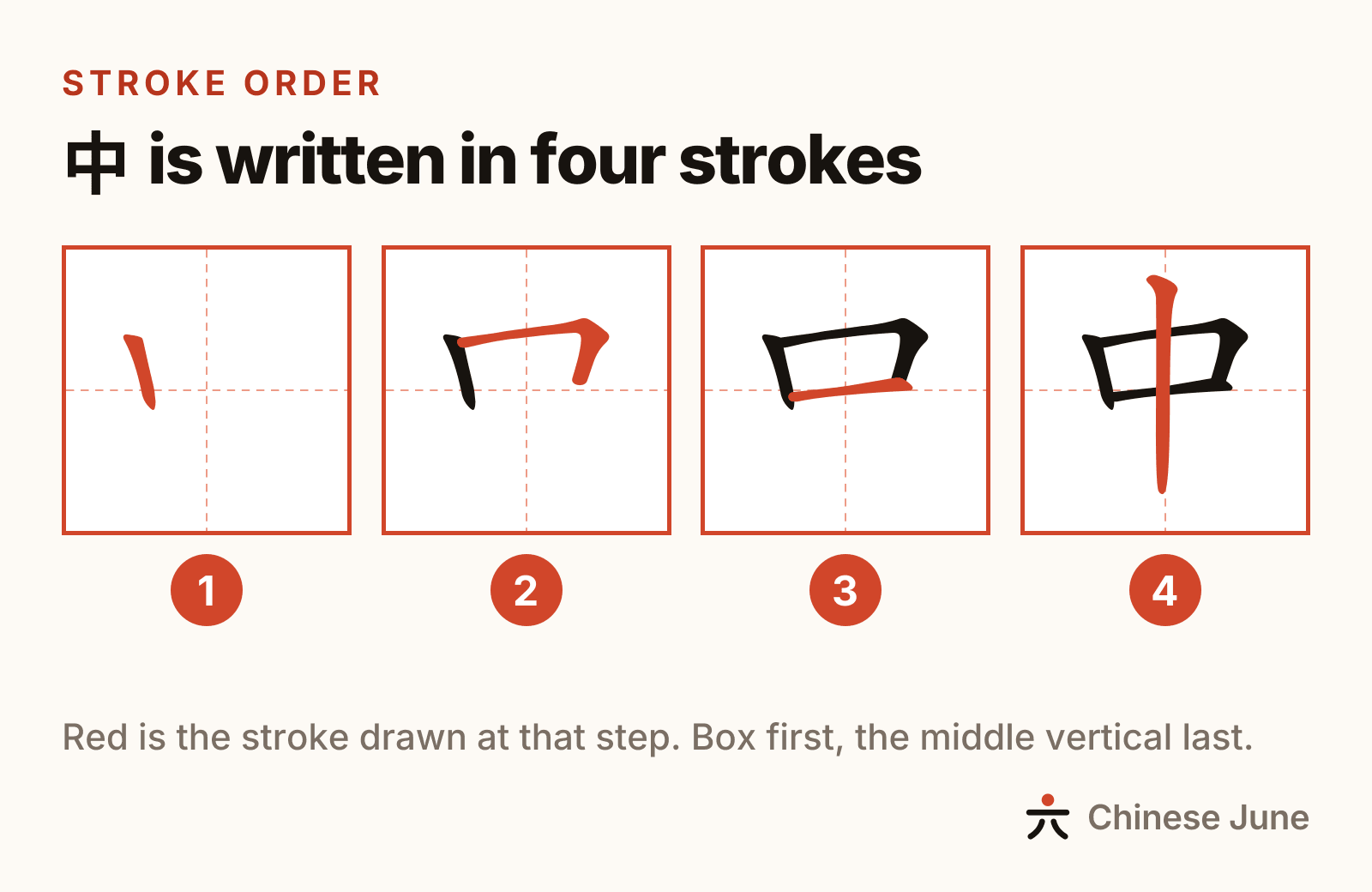
中 is four strokes: the left side, the top and right side in one move, the bottom, and last the vertical that cuts through them all. Chinese children practice this in squared notebooks like the one pictured; the dashed lines help center the character in the box.
Learning the order pays off twice. When you look up an unfamiliar character by drawing it on your phone with a finger, recognition works far better if the strokes come in the right order. And once your hand knows the order, it stops drawing the character and starts writing it; that is what sticks.
How many characters are there, and how many are enough?
How many there are depends on which dictionary you open. The Kangxi Dictionary of 1716 has a little over 47,000. The second edition of the Hanyu Da Zidian has 60,370, the Zhonghua Zihai 85,568. The numbers are scary but misleading: most are forms nobody has used for centuries, place names and old variant spellings.
The numbers that matter are far smaller:
And the frequent characters cover a surprisingly large share of a text:
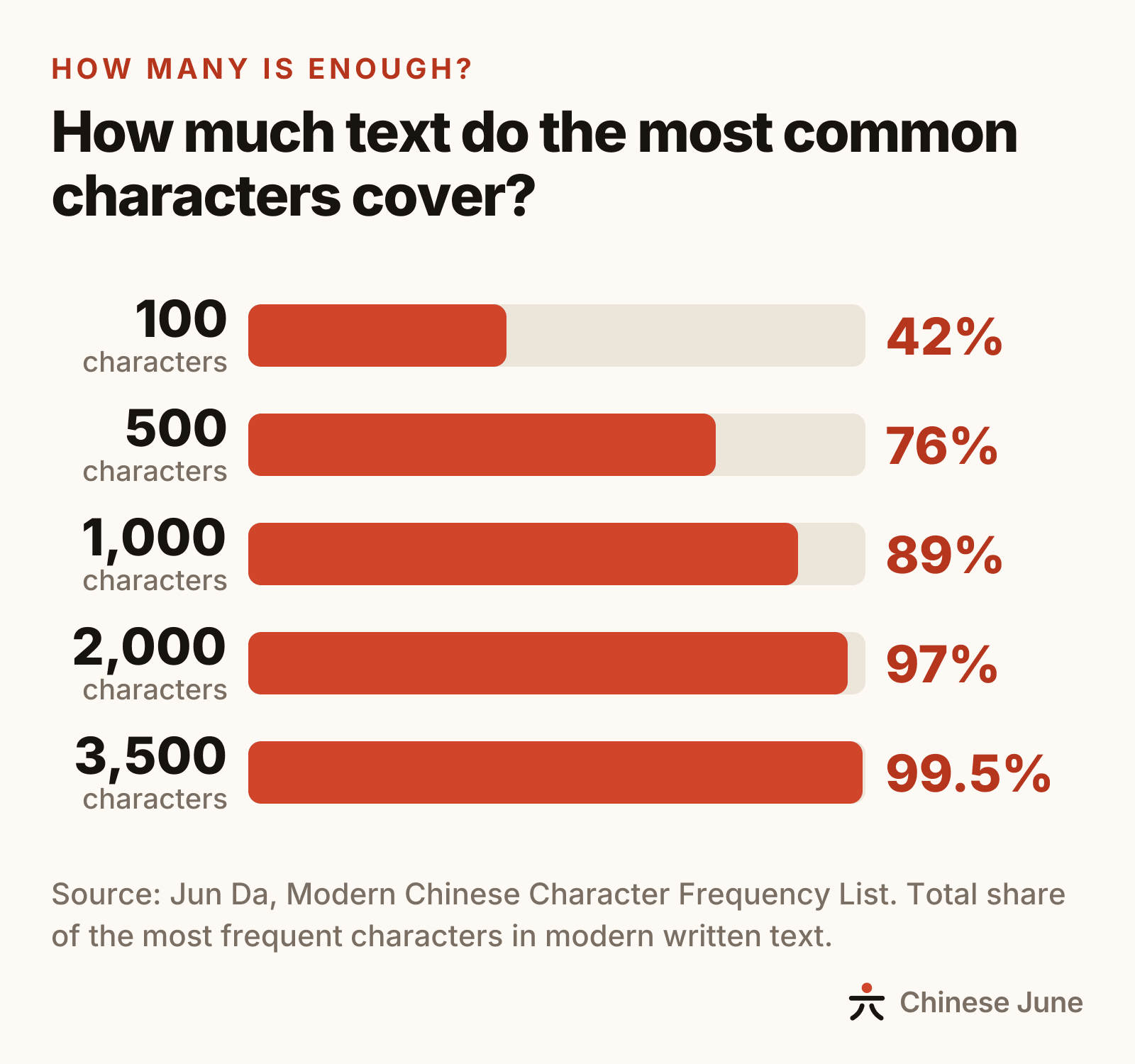
The 500 most frequent characters cover three quarters of the characters in an ordinary text; 1,000 cover 89 percent. One honest caveat: recognizing 89 percent of the characters is not the same as understanding 89 percent of the text. Meaning lives in words, and words are mostly two characters put together. Still, the curve is encouraging. Effort pays off most at the very start.
As for exams: in the HSK's current six-level format, level 1 asks for 150 words and 174 characters, and the first two levels have no writing section. In the new format (HSK 3.0) level 1 goes up to 300 words and 246 characters; its first official exam has been announced for December 13, 2026.
Simplified or traditional?
Chinese characters come in two sets. Simplified characters (简体字) were drawn up in China in the 1950s to spread literacy; the first official scheme came out in 1956. Today mainland China, Singapore and Malaysia use this set. Traditional characters (繁體字) live on in Taiwan, Hong Kong and Macau.
Not every character differs. Where the two sets part ways, it is mostly that the stroke count has gone down:
| Meaning | Simplified | Traditional |
|---|---|---|
| horse | 马 | 馬 |
| mother | 妈 | 媽 |
| country | 国 | 國 |
| to study | 学 | 學 |
| book | 书 | 書 |
| love | 爱 | 愛 |
The last row is the best-known example in this debate: traditional 愛 has 心 (heart) in the middle, and the simplified form does not. Defenders of traditional characters like to ask how there can be love without a heart.
Which set to learn depends on where you will use your Chinese. Unless you plan to study or live in Taiwan, start with simplified: the HSK exam, nearly all the content that comes out of China and our cards use this set. Learn one and you are not starting the other from zero; most of the parts are shared.
How do Chinese people type?
There is no keyboard with tens of thousands of keys. The most common method is pinyin: you type the pronunciation in Latin letters, the keyboard lists the characters that match the sound, and you pick one. Type “nihao” and the first suggestion is 你好. In one survey in China, roughly three quarters of users said this is the method they use most.
There are other ways: drawing the character with a finger, dictating, or shape-based methods such as Wubi. In Taiwan most people use Zhuyin instead of pinyin, a separate sound script of 37 symbols popularly known as “bopomofo”.
To try it, add the “Chinese (Simplified) – Pinyin” keyboard in your phone's keyboard settings. On most phones there is no separate app to install.
Two things follow. First, you cannot type Chinese without knowing pinyin. Pinyin is not a step you climb at the start and then forget; it is the keyboard you will use for life. Second, Chinese people now write by hand less too, and forget some characters. Chinese even has a name for that: 提笔忘字 (tí bǐ wàng zì), “pick up the pen, forget the character”.
How is your name written in Chinese?
Syllable by syllable, not letter by letter. Chinese writes foreign names with the characters that sound closest to each syllable. Which character goes with which syllable is not a free-for-all either: news agencies and publishers follow transliteration tables drawn up for each language.
Place names make it easy to see:
| In English | In Chinese | Pinyin | Sounds like |
|---|---|---|---|
| London | 伦敦 | Lúndūn | lwun2 dwun1 |
| New York | 纽约 | Niǔyuē | nyoh3 yueh1 |
| Sydney | 悉尼 | Xīní | shee1 nee2 |
| Toronto | 多伦多 | Duōlúnduō | dwaw1 lwun2 dwaw1 |
| Scotland | 苏格兰 | Sūgélán | soo1 guh2 lahn2 |
Scotland has gone from two syllables to three. The reason is the shape of a Chinese syllable: it almost always ends in a vowel or in n or ng, and two consonants cannot stand side by side. So “sc” opens out into “soo-guh”, and the d at the end of “land” simply drops.
Personal names work the same way. A few of them, as the Chinese news media spell them:
| Name | In Chinese | Pinyin | Sounds like |
|---|---|---|---|
| John | 约翰 | Yuēhàn | yueh1 hahn4 |
| James | 詹姆斯 | Zhānmǔsī | jahn1 moo3 sz1 |
| Michael | 迈克尔 | Màikè'ěr | mai4 kuh4 ar3 |
| David | 大卫 | Dàwèi | dah4 way4 |
| William | 威廉 | Wēilián | way1 lyen2 |
| Thomas | 托马斯 | Tuōmǎsī | twaw1 mah3 sz1 |
| Jack | 杰克 | Jiékè | jyeh2 kuh4 |
| Mary | 玛丽 | Mǎlì | mah3 lee4 |
| Elizabeth | 伊丽莎白 | Yīlìshābái | ee1 lee4 shah1 bai2 |
| Sarah | 萨拉 | Sàlā | sah4 lah1 |
| Charlotte | 夏洛特 | Xiàluòtè | shyah4 lwaw4 tuh4 |
| Lucy | 露西 | Lùxī | loo4 shee1 |
A few things will have caught your eye. John hardly sounds like John: 约翰 follows the old biblical form of the name (think Johannes), and the spelling has long been fixed. Lucy is two characters and reads almost as it is. The k of Jack and the final s of James and Thomas have each picked up a vowel and become a syllable of their own, and the l of Michael is covered by 尔 (ěr), the nearest sound Chinese has. Surnames stretch the most: Smith, one syllable in English, becomes three as 史密斯 (Shǐmìsī). You will also meet more than one spelling of the same name: David is 大卫 by long habit, but news reports also write 戴维 (Dàiwéi).
Sports clubs get the same treatment: Liverpool is 利物浦, Arsenal is 阿森纳, and the Los Angeles Lakers are 洛杉矶湖人, the city by sound and “Lakers” by meaning (湖人, “lake people”). Taylor Swift is 泰勒·斯威夫特 in the Chinese press. The dot between given name and surname stands in for the space in foreign names.
The meaning of the chosen characters does not count; they are there for the sound and are picked to be neutral on purpose. Brands go a step further and play on sound and meaning at once. Coca-Cola in Chinese is 可口可乐 (kěkǒu kělè): it sounds like the brand and means “tasty and enjoyable”. IKEA is 宜家 (Yíjiā, “suits the home”), Mercedes-Benz is 奔驰 (Bēnchí, “to gallop”).
The “Chinese name” that learners take is something else entirely: not a transliteration but a real name of two or three characters, the kind Chinese people have. A teacher or a Chinese friend usually picks it.
Where should you start?
The order matters, because most people who start in the wrong order get stuck in the same place. This is the order we suggest:
A starting point for that last item: our HSK 1 deck is free. It holds the hundred words you need most when you start Chinese, plus the numbers; every card has the character, the pinyin, a “Sounds like” line and a short note.
Frequently asked questions
How many letters are there in the Chinese alphabet?
None, because Chinese has no alphabet. It is written with characters; around 3,500 are in everyday use. Pinyin, which shows the pronunciation, uses 25 letters of the Latin alphabet (all except v) plus ü. That is not an alphabet either; it is a way of spelling out pronunciation.
Is Chinese written from left to right?
Today, yes: in China text runs from left to right, line by line. The People's Daily (人民日报) switched to horizontal typesetting on January 1, 1956. The traditional layout runs from top to bottom, with the columns arranged from right to left; you still see it in books printed in Taiwan and in calligraphy.
Do Japanese and Korean use the same characters?
Japanese does in part: it mixes characters of Chinese origin (kanji) with two syllabaries of its own (hiragana and katakana). Korean is written with the 24-letter Hangul alphabet; characters of Chinese origin (hanja) are rarely seen today. Of the three, only Korean has a real alphabet.
Are Chinese and Mandarin the same thing?
In everyday use, “Chinese” means Standard Chinese (普通话, Pǔtōnghuà), and Mandarin is the English name for it. China also has other languages, such as Cantonese, whose speakers cannot understand one another, but in writing they largely use the same characters. Pinyin writes the sounds of Standard Chinese only.
How long does it take to learn pinyin?
The reading rules, meaning which letter stands for which sound, take a few evenings. Producing the sounds correctly and telling the tones apart takes longer: weeks of listening and repeating. Keep the two apart: being able to read pinyin does not mean your pronunciation has settled.
Do I have to learn to write characters by hand?
Not to get started. Recognizing a character and being able to type it on a pinyin keyboard covers nearly everything you need day to day. Handwriting is good for memory because it makes you notice the parts of a character, but when to add it is up to you.
Which Chinese character has the most strokes?
The example quoted most often is “biáng”, which appears in the name of a noodle dish from Shaanxi province: 58 strokes in its traditional form. It is so unusual that it could not be typed on a computer until 2020 (Unicode 13.0). It still does not display on most phones, which is why we could not put it here either.